CX
automobile
Guest post by CEO Holger von Seherr-Thoss
Artificial intelligence has noticeably advanced customer experience in the automotive sector in recent years. Today, feedback is systematically collected, merged across numerous touchpoints, and evaluated in real time. AI helps to structure large amounts of data, make patterns visible, and set priorities more clearly.
Particularly in complex dealer networks, this is a decisive step forward. Transparency is created where previously individual perspectives dominated. Differences between locations become visible, and critical developments are identified sooner. In this sense, AI has long ceased to be a future topic and is now an integral part of modern CX management.
And that is precisely why the actual question is shifting.

AI in Automotive CX: The difference is made in the moment of interaction
Artificial intelligence has noticeably advanced customer experience in the automotive sector in recent years. Today, feedback is systematically collected, merged across numerous touchpoints, and evaluated in real time. AI helps to structure large amounts of data, make patterns visible, and set priorities more clearly.
Particularly in complex dealer networks, this is a decisive step forward. Transparency is created where previously individual perspectives dominated. Differences between locations become visible, and critical developments are identified sooner. In this sense, AI has long ceased to be a future topic and is now an integral part of modern CX management.
And that is precisely why the actual question is shifting.
AI has measurably advanced Customer Experience
Artificial intelligence has noticeably advanced Customer Experience in the automotive sector in recent years. Today, feedback is systematically collected, aggregated across numerous touchpoints, and evaluated in real time. AI helps to structure large amounts of data, make patterns visible, and set priorities more clearly.
Especially in complex dealer networks, this is a decisive step forward. Transparency is created where previously individual perspectives dominated. Differences between locations become visible, and critical developments are detected earlier. In this sense, AI is no longer a future topic, but an integral part of modern CX management.
And that is precisely why the actual question is shifting.
The decisive moment lies in the interaction
Today, it is less about whether data is available or how it is analyzed. Rather, the decisive factor is what happens in the next step – namely, at the moment of customer interaction.
Because that is where the actual customer experience is created.
A visit to the workshop, a consultation at the dealership, or an unexpected situation in service are not abstract processes, but concrete encounters. This is where it is decided whether a customer builds trust, whether a problem is resolved satisfactorily, and whether a single experience turns into long-term loyalty.
AI creates clarity – but does not replace experiences
AI can achieve a lot in this context. It can provide hints, flag anomalies, and make priorities visible. It can filter the relevant signals from thousands of pieces of feedback and ensure that critical issues are not overlooked. In doing so, it creates the foundation for better and faster decisions.
What it cannot do is the actual interaction.
Whether a customer feels taken seriously, whether a conversation takes place on equal terms, or whether a problem is resolved convincingly, is decided in direct contact. It is these moments in which analysis becomes actual experience.
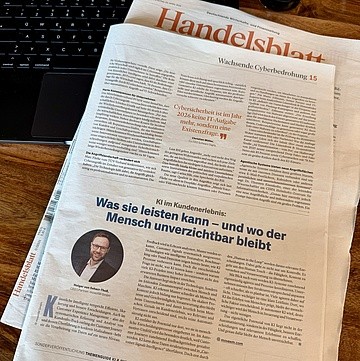
Read more about this topic in the Handelsblatt.
Click here for the guest article by CEO Holger von Seherr-Thoss
From Insight to Actual Experience
This is exactly where the central challenge in automotive CX lies today: not in understanding the data, but in systematically translating insights into action. It is about ensuring that knowledge reaches those places where it is relevant – and that it unfolds the right impact at the right moment.
The new balance in Automotive CX
The discussion about artificial intelligence therefore falls short if it revolves solely around technological possibilities. The key is not what can be automated, but how technology and human action interact meaningfully.
The future of Customer Experience in automotive will not be determined by an "AI-first" mindset. It is created through interplay. AI provides speed, structure, and guidance. Humans bring context, responsibility, and relationship.
The difference is made where both come together – in the concrete moment of interaction.
Because in the end, customers do not remember systems or analytics.
They remember how they were treated.

Author:
Barbara D'Emilio
Automotive
B2B


