automobile
CX
Insights from Barbara DʼEmilio
The critical challenges for the customer experience are increasingly arising after the vehicle purchase. Today, customers no more evaluate only the vehicle itself. They evaluate the charging experience, digital vehicle features, and the transition between online contact and personal consultation. This is exactly where trust is built - and whether loyalty is maintained.
Three developments are currently shaping this change in particular: the growing importance of the ownership phase, trust in connected services, and the seamless connection between digital and personal touchpoints. At the same time, these topics are increasingly reflected in tenders and strategic CX initiatives.

CX in the Automotive Sector 2026: Ownership, Trust, and the Last Mile
The critical challenges for the customer experience are increasingly arising after the vehicle purchase. Today, customers no more evaluate only the vehicle itself. They evaluate the charging experience, digital vehicle features, and the transition between online contact and personal consultation. This is exactly where trust is built - and whether loyalty is maintained.
Three developments are currently shaping this change in particular: the growing importance of the ownership phase, trust in connected services, and the seamless connection between digital and personal touchpoints. At the same time, these topics are increasingly reflected in tenders and strategic CX initiatives.
1. Automotive Reality: EV Ownership After the Hype
2026 shows a clear shift in sentiment: discussions about electric vehicles are less about innovation and more about everyday usability. In EV ownership, friction points are becoming clearly visible – particularly frustration with charging infrastructure outside urban areas, long repair wait times, and unclear communication in customer service.
For CX programs in the OEM environment, this means the focus is shifting from the purchase phase to the ownership phase – service transparency, repair communication, and the charging experience are becoming the decisive loyalty factors.
In practical terms, this means for touchpoint programs: The ownership phase deserves at least as much measurement attention as closing the sale. Anyone who only surveys EV owners again during the next purchase cycle misses the exact phase where loyalty is decided or broken.
A blind spot remains the charging infrastructure: The frustration about this typically does not arise at the dealership or in the workshop, but on the road at public charging stations – thus outside any touchpoint where a classic service survey would be triggered. This signal therefore becomes visible primarily where customers vent their anger unsolicited: in Google Reviews, on social media. For CX programs, this means systematically complementing structured surveys with social listening and review mining, rather than relying solely on their own touchpoints.
The effect is by no means just a satisfaction issue, but directly impacts purchasing behavior: according to an analysis by Strategic Vision, dissatisfaction with public charging drives 25% of EV owners back to internal combustion engines for their next purchase. McKinsey survey data also shows that charging speed and network availability are among the strongest levers for influencing purchase decisions in favor of an electric vehicle. Charging infrastructure feedback is therefore not just a service topic, but an early indicator of churn during the next vehicle purchase.
Source: Brandwatch – Consumer Trends Shaping the Automotive Industry in 2026
2. Trust as Currency: Connected Services & OTA Updates
Customers show the highest willingness to pay for safety-relevant connected services such as emergency assistance, automatic accident detection, and anti-theft protection. At the same time, data from connected devices, in-cabin cameras, and location data trigger the greatest concerns – a clear signal of the need for more transparency in connected services.
On a positive note: Many customers would keep their vehicle one to three years longer if it receives regular over-the-air updates with new features. Software updates thus become a measurable loyalty lever – provided there is trust in the handling of vehicle data.
For CX programs, this concretely means: Questions about data transparency and control belong in the journey survey after purchase and software update – not just the classic satisfaction with the new feature, but also the feeling of control over one's own vehicle data.
Source: Deloitte – 2026 Global Automotive Consumer Study
On a side note: The market for feedback and CX software is currently undergoing one of the most active consolidation phases in years – several major providers have merged or changed ownership within a few months. For automotive clients with very specific requirements (dealership network feedback, factory service, group brand differentiation), a second look during this phase is worthwhile to see which partner brings the necessary industry depth and continuity – regardless of size.
3. The Last Mile in Retail: Digital-Physical Friction
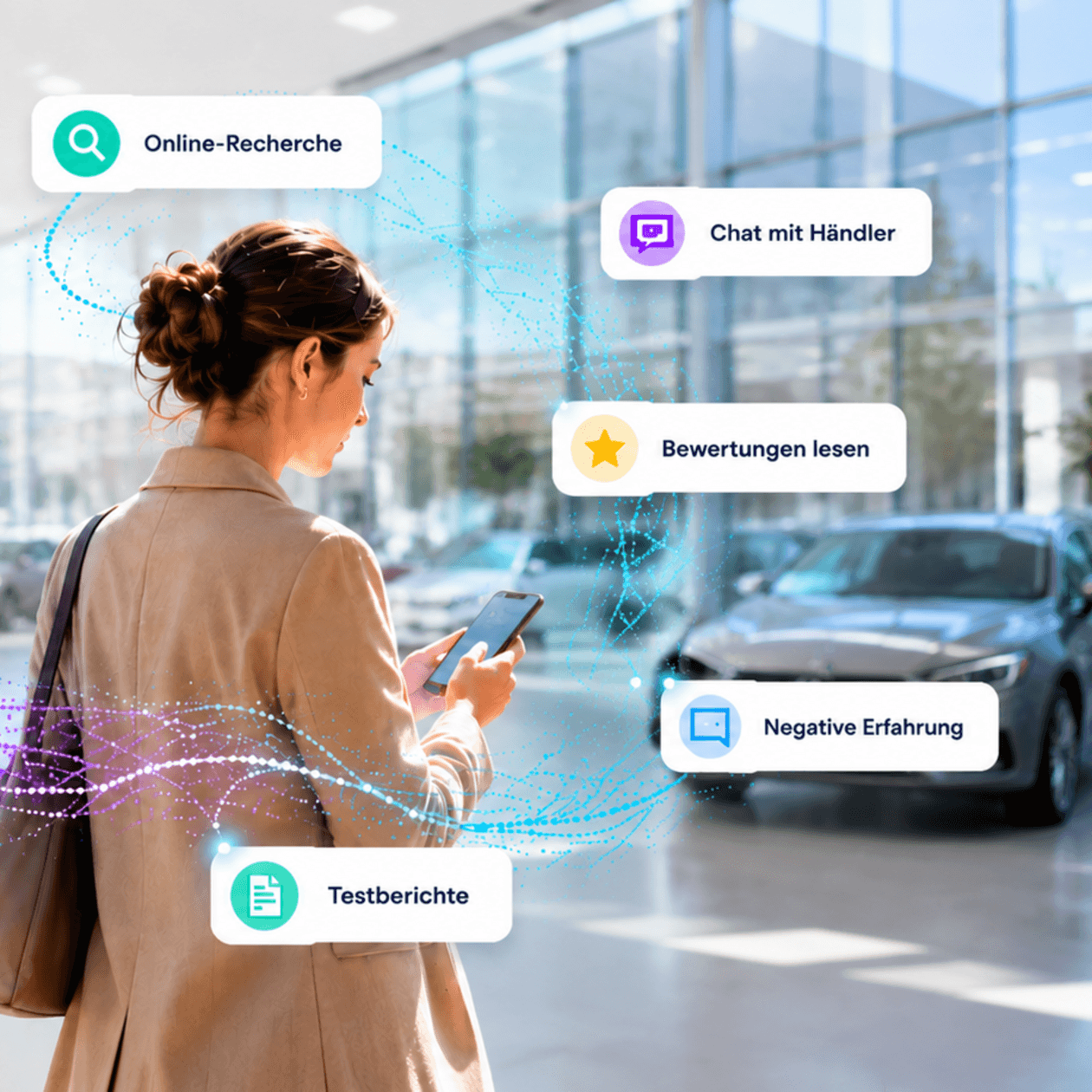
Customers do not expect dealerships to be an e-commerce platform, but a competent service business: one that answers the phone, remembers the customer, and does not make them start over with every channel change. A customer who fills out a trade-in form online and has to explain everything to the salesperson over the phone again does not have a real omnichannel experience – but rather two separate systems.
For dealer network CX programs, connecting the initial digital contact and physical consultation remains the decisive lever against customer churn.
Source: Flai – Automotive Customer Experience Trends for Dealers (2026)
Conclusion for your CX program
● The ownership phase – service, repair, charging – increasingly decides loyalty, not just the purchase.
● Transparency with vehicle data is a prerequisite for unlocking the loyalty potential of connected services and OTA updates.
● Seamless transitions between digital and personal contact remain the biggest hurdle in retail.
● In a consolidating software market, industry depth is gaining importance – for your choice of CX partner.

Author:
Barbara D'Emilio
Customer Experience Management
Automotive